Important parking update: Changes improve convenience, flexibility

With the introduction of HonkMobile to support cashless parking at both Niagara College campuses, students, employees and visitors will have improved convenience and flexibility for on-campus parking this fall.

Permits and passes are available for purchase for Fall term and beyond through HonkMobile, with a variety of options to choose from. The array of options are designed to suit the diverse parking needs of the College community as students, staff and visitors plan for varying degrees of on-campus activity starting in September, while others will study or work remotely.

Long-term permits may be purchased monthly (for one month or up to 12 months, ending August 31, 2021). Shorter-term options are also available for hourly, daily or weekly passes. Those who intend to purchase parking more than two days a week will find it more cost effective to purchase a permit.

On-campus parking enforcement will resume on the first day of classes for Fall term (September 9).

View 2020-2021 parking rates here to select the option that’s right for you.

Cashless, paperless parking

No matter which option you choose, HonkMobile is now the only way to pay for all on-campus parking for permits/passes beginning September 1 at Niagara College.

Convenient, cashless, and paperless, purchasing parking through HonkMobile will replace physical hanging parking permits or paper receipts that were previously required to be displayed in vehicles. No need to worry about lost or stolen permits or transferring permits from one vehicle to another.

Purchase parking through HonkMobile

For detailed instructions and information about purchasing parking through HonkMobile:

To purchase parking through HonkMobile visit the website at honkmobile.com, download the HonkMobile app for iOS or Android devices, or tap your mobile device at one of the HonkMobile tap meter locations located in the parking lots and designated entrances and throughout the campus.

Select a zone for either campus:

    • Welland Campus: The app will display two Zone IDs for the Welland Campus.

Select Zone 2600 for Lot A (daily paid parking only), or 2601 for Lots B, C, D, E, F and G, (permit and daily paid parking).

    • Niagara-on-the-Lake campus: The app will display one Zone ID for the NOTL campus. Select Zone 2607 (permit and daily paid parking).

For those who travel between campuses, parking purchased for one Niagara College campus will be valid at the other campus (excluding Welland Lot A).

Honk will require vehicle information and payment. It is vital to ensure the licence plate information provided to Honk is correct (an incorrect licence plate will result in a parking ticket). Up to three licence plates may be registered for each parking permit/pass. Only one vehicle registered to the pass will be allowed on campus at any given time.

Students, staff and visitors without a mobile device can also pay for hourly, daily, and weekly parking at a HonkMobile tablet kiosk. Locations at the Welland Campus include the Applied Health Main Entrance and the Rankin Technology Centre – West Entrance (near Lot D).  At the Niagara-on-the-Lake campus, a tablet kiosk will be available near the main entrance (front).

Unsure about how much time you need to purchase? No problem! Those who pay for parking will receive a notification 15 minutes before their parking is scheduled to expire, allowing users to add extra time, if needed.

Parking FAQs

Which parking option is right for you?

Those who intend to purchase parking more than two days a week will find it more cost effective to purchase a permit.

Can I register more than one vehicle for my parking permit?

Up to three licence plates may be registered for each parking permit. Only one registered vehicle will be permitted to park at one of the campuses at any given time.

What if I travel between campuses?

Purchasing a parking permit for the Welland Campus (Zone 2601) will also allow you to park at the NOTL Campus (Zone 2607) – and vice versa (excluding Lot A at the Welland Campus, Zone 2600). Only one licence plate registered to the parking pass is permitted on campus any given time.

Do I need a physical parking permit or a receipt to display on my dashboard?

No physical pay-and-display ticket or permit will be issued. Digital parking permits are now issued through the HonkMobile app and at HonkMobile pay kiosks on campus.

Is visitor parking available on campus?

There are a limited number of 30-minute courtesy visitor parking spaces available at each campus. Parking spaces are clearly marked with signs and are patrolled.

Courtesy parking is available to visitors to Welland Campus Dental Clinic, as well as Niagara-on-the-Lake Teaching Brewery Retail Store, Wine Visitor + Education Centre, Teaching Greenhouse, and Teaching Spa.

Ticketing/Towing

Vehicles may be ticketed and/or towed if they are parked illegally, blocking laneways, or improperly parked. Tickets are issued by the Town of Niagara-on-the-Lake (Niagara-on-the-lake Campus) and the City of Welland (Welland Campus). Vehicle owners are responsible for their own vehicles and payments towards parking tickets and/or towing.

What if I wish to dispute a ticket?

Questions regarding ticketing should be directed to HonkMobile and/or the municipality that issued the ticket (Town of Niagara-on-the-Lake or City of Welland).

Honk Mobile: email [email protected]

Town of NOTL Paying-Disputing Penalty Notices

City of Welland – Parking Tickets

For more info

Visit NC’s Parking Services website, call 905-735-2211 ext. 7407, or email [email protected].

Artisan Distilling program’s first rum wins bronze at U.S. competition

Spirits are high at the Niagara College Teaching Distillery after a student-produced rum won bronze at the U.S. Open Whiskey and Spirits Championships.

The accolades for School Spirits Small Batch Rum, produced by the first students to graduate from the Artisan Distilling program, came in the Dark/Barrel Aged Rum category of the competition, which included entries from throughout Canada and the U.S. Niagara College was the only teaching distillery to be among the winners in any category.

“It feels good to win an award like this,” said David Dickson, College distiller. “It instills a sense of pride that, in such a short time, our students have been able to develop to such a level to create a high quality spirit. To be able to achieve this in such a short time feels like a real feather in our cap.”

The award-winning rum was a year in the making by students, who saw their handiwork compete against rums aged longer or blended with spirits from elsewhere. Production of the School Spirits Small Batch Rum started six months into the year-long program when students began fermenting dark brown sugar. All signs pointed to something special in the works after their first distillation using small copper pot stills to capture only the best fraction of the spirit. 

The rum was fermented in a two-week process, which is slower than typical production, and led to a more complete attenuation of sugar by the yeast. Students took charge of the entire process, Dickson noted, signing their name to the 57-litre bourbon cask in which the spirit was left to age for 12 months, the minimum a Canadian rum must mature in a barrel.

“Then they went off in their careers. It was sort of like a time capsule,” Dickson said. “Their finesse was what caused the spirit to age like it did.”

The result was a rum with a surprising golden colour, and a clean and balanced aromatic profile with notes of vanilla and candied fruit. It’s dry and light in body compared to rums with added sweeteners. The finish has a pleasing texture with vanilla, caramel and a touch of bourbon spice.

“Our first student-crafted rum clearly demonstrates our students’ talents and skills when it comes to distillation and fermentation,” said Steve Gill, general manager of Niagara College’s Learning Enterprises. “The fact that they so confidently took on the production of rum and then earned such honours alongside spirits produced by more established distilleries elsewhere in North America also speaks to the quality of teaching happening in our Artisan Distilling program. It shows that the future of craft distilling in Canada is in capable hands.”

Two hundred 375-millilitre bottles of School Spirits Small Batch Rum were released for sale earlier this summer at the Wine Visitor + Education Centre (Niagara College Daniel J. Patterson Campus, 135 Taylor Rd., Niagara-on-the-Lake). The rum sells for $26 with proceeds from sales supporting student learning.

Visit usopenwhiskey.com to learn more about the awards. 

Niagara College’s Teaching Distillery is a 2,500-square-foot facility equipped with five stills, four mash tuns and 10 fermenters. Home to the College’s Artisan Distilling program, students produce a variety of distilled products including vodka, gin, brandy, rum, whisky and other spirits. It opened in September 2018, completing the trifecta of beverage fermentation sciences at NC’s learning enterprises, following the footsteps of its Teaching Winery and Teaching Brewery which were also the first of their kind in Canada.

Niagara College offers more than 150 diploma, bachelor degree and advanced level programs; as well as more than 600 credit, vocational and general interest Part-Time Studies courses. Areas of specialization include food and wine sciences, advanced technology, media, applied health and community safety, supported by unique learning enterprises in food, wine, beer, distilling, horticulture and esthetics. For more information visit niagaracollege.ca.

-30-

Julie Greco
Communications Consultant, Niagara College
Cell: 905 328 2532
[email protected]

Michael Wales
Manager, Corporate Communications
Cell: 905-328-4101
[email protected]

Teaching Winery whites strike gold in national competition

Excitement is bubbling up at the Niagara College Teaching Winery after two wins at a national competition – including a trophy for Best Sparkling Wine of the Year.

The All Canadian Wine Championships (ACWC) awarded the NC Teaching Winery’s 2014 Balance Blanc de Blanc Brut the coveted title of Best Sparkling Wine of the Year, along with a Double Gold trophy in the Sparkling Wine (Traditional Method category), while its 2017 Les Marmitons Gastronomy Chardonnay won Gold in the Chardonnay Under $20 category.

ACWC director Bev Carnahan noted that this year marked the 40th running of the wine competition – one of the oldest in the world. The 2020 competition drew 805 wine entries from 130 participating wineries across Canada. Judging was held in Prince Edward County beginning July 20 and results were posted on July 25.

Carnahan applauded the NC Teaching Winery for being among three first-time trophy winners this year.

“This is a testament to the calibre of program being headed by Gavin Robertson,” said Carnahan. “It bodes well for the future of Canada’s wine industry.”

News about the wins was well received at the NC Teaching Winery.

“These latest award-winning wines truly celebrate the knowledge, skills and creativity of our winemakers, faculty and students at the Niagara College Teaching Winery,” said Steve Gill, general manager of NCs Learning Enterprises. “This outstanding national achievement continues to raise the bar for high-quality wine education across Canada.”

Two wines which won awards at the 2020 All Canadian Wine Championships are pictured on the patio of the Wine Visitor + Education Centre, overlooking the College’s Teaching Vineyards: Balance Blanc de Blanc Brut 2014 and Les Marmitons Gastronomy Chardonnay 2017.

First released in early 2019, 2014 Balance Blanc de Blanc Brut was the Teaching Winery’s first venture into the style of Sparkling made exclusively from Chardonnay grapes. The traditional method, bottle-fermented Sparkling was made from high quality, handpicked, bunch sorted Chardonnay grapes fermented in steel tanks and neutral oak barrels, and aged for 36 months on yeast lees before disgorging.

2017 Les Marmitons Gastronomy Chardonnay is an estate-grown, barrel-fermented Chardonnay, which spent 11 months ‘sur lie’ in French barriques and underwent malolactic fermentation with monthly lees stirring. The wine appears as a bright straw colour in the glass and the nose offers ripe pear, apple, Meyer lemon, vanilla and oak flavours. The palate is rich and creamy with more stone fruit flavours, and undertones of caramelized brown sugar, nutmeg, and a lively acid backbone that structures the wine.

The awards add to previous hardware won by both wines, including a gold for the 2014 Balance Blanc de Blanc and a silver for the 2017 Les Marmitons Gastronomy Chardonnay from the 2019 WineAlign National Wine Awards of Canada.

College Winemaker Gavin Robertson noted that College Chardonnays tend to do well in competition.

“The campus vineyard Chard block produces really beautiful fruit that we’re able to spend a lot of time working on in the growing season: pruning, shoot thinning, tucking, cluster thinning, and handpicking,” he said. “Students are involved in all of these activities because we use the vineyard as a living classroom for labs that support the viticultural sciences that they are exposed to in lecture.”

The College has won numerous awards from the ACWC over the past few years for many different wines – from Icewine, Brut, and Semi-Dry Riesling, to Sauvignon Blanc, Chardonnay, Viognier and Pinot Noir.

“It’s important that we win in diverse categories. We endeavor to produce wines in as many styles that are available in the Ontario industry as possible, to showcase as many production techniques to students as we can,” said Robertson, who is a graduate of the College’s Winery and Viticulture Technician (2011) and a Nuffield Canada scholar.

The wines are available for purchase at the Wine Visitor + Education Centre (Niagara College Daniel J. Patterson Campus, 135 Taylor Rd, Niagara-on-the-Lake), or online at NiagaraCollegewine.ca  Proceeds from sales support student learning.

For info about the ACWC visit allcanadianwinechampionships.com.

Niagara College’s Teaching Winery is the first and only commercial teaching winery in Canada. It is located at the College’s Niagara-on-the-Lake Campus, along with the NC Teaching Brewery and the NC Teaching Distillery, which were also the first of their kind in Canada.

Niagara College offers more than 150 diploma, bachelor degree and advanced level programs; as well as more than 600 credit, vocational and general interest Part-Time Studies courses. Areas of specialization include food and wine sciences, advanced technology, media, applied health and community safety, supported by unique learning enterprises in food, wine, beer, spirits, horticulture and esthetics. For more information visit niagaracollege.ca.

Pictured top of page:  College winemaker Gavin Robertson stands in the NC Teaching Vineyards with a bottle of Balance Blanc de Blanc Brut 2014 that won a Double Gold trophy and was named Best Sparkling Wine of the Year at the 2020 All Canadian Wine Championships.

-30-

Media inquiries, please contact:


Julie Greco

Communications Consultant, Niagara College

Cell: 905 328 2532

[email protected]

Niagara College 2020 Civic Holiday hours

While there is limited activity and restricted access to campuses at this time, due to measures related to COVID-19, Niagara College is offering many services virtually, or via alternative delivery, and NC’s learning enterprises are either open or offering curbside pickup.

Below is a list of what will be open or closed for the Civic holiday on Monday, August 3.

Wine Visitor + Education Centre: Retail store and patio will be open August 3. Tasting, shopping, patio drinks and snack service is available daily from 10 a.m. to 5 p.m. Products include NC wine, beer, cider and spirits. For curbside pickup, local delivery and shipping across Ontario, please call 905-641-2252 ext. 4070 or visit niagaracollegewine.ca.

Community Employment Services: (43 Church St. in St. Catharines): Closed August 3. Virtual services resume on Tuesday, August 4 and are available weekdays from 8:30 a.m. to 5 p.m. In addition, the CES office is now open for in-person visits Monday, Wednesday and Thursday 8:30 a.m. to 4:30 p.m. by appointment. Visit the CES website for more information.

Enrolment Services:
Closed August 3. Students may continue to submit requests online via email and student portal, which will be reviewed in priority sequence when Enrolment Services reopens on Tuesday, August 4.

NC Teaching Greenhouse:
Closed August 3. Open for curbside pickup only resuming Tuesday, August 4. Visit the Teaching Greenhouse’s online store to place an order and learn more.

ncLibraries and Learning Commons:
Student support, academic drop-ins and peer tutoring services will be closed on August 3. Virtual services will resume on Tuesday, August 4 and online resources are available 24-7 at niagaracollege.ca/library.

Student centres and NCSAC offices:
Closed August 3. Virtual services resume on Tuesday, August 4.

For a comprehensive list of services and resources available to assist students, visit:
Virtual Campus: Remote Services, Resources for Students

Transit

Please check with individual transit providers for the most up-to-date information and schedules.

Niagara Region Transit
St. Catharines Transit Commission
Welland Transit (including Port Colborne)
Niagara Falls Transit

Important note: The student U-Pass has been suspended for the Spring and Fall term during COVID-19. All student riders are required to pay the adult fare as of July 1, 2020. Monthly passes are available for purchase at the Welland, St. Catharines and Niagara Falls terminals and some transit providers offer a mobile Transit App.

For fare information and the latest updates, visit the transit websites listed above.

Visit yourncsac.ca/yourtransit for more information and Frequently Asked Questions related to student transit.

Niagara College to advance healthcare education with NSERC grant

Niagara College has been awarded federal government funding to help improve healthcare access for homeless and vulnerable individuals struggling with diabetic foot problems.

Called ‘An Interprofessional Train-the-Trainer Solution to the Diabetic Foot-Care Crisis Within Community Shelters,’ the grant of $209,576 (over two years) is from the Natural Sciences and Engineering Research Council (NSERC) College and Community Social Innovation Fund (CCSIF). It will allow NC and its academic and community partners to address and improve healthcare access for individuals needing essential diabetic foot care, as well as improve implementation by healthcare professionals at homeless shelters.

The CCSIF program, in collaboration with Canada’s Social Sciences and Humanities Research Council (SSHRC) and the Canadian Institutes of Health Research (CIHR), is designed to support college research projects in partnership with local community organizations to foster social innovation in areas such as education, integration of vulnerable populations, and community development.

Diabetes can cause serious changes to the body that often affect the feet and toes, and when left untreated, can result in a limb-threatening condition. According to Diabetes Action Canada, a lower-limb amputation occurs every four hours in Ontario. A significant number of these can be prevented with proper, daily foot care.

Niagara College, in collaboration with the Michener Institute of Education at the University Health Network and local community facilities and shelters, will use the Train-the-Trainer model to educate and provide awareness of diabetes and foot-care needs for at-risk individuals. The project will also enable capacity building among other health professions typically not responsible for foot care, yet essential for triaging and providing treatment.

The first grant of its kind for NC under this program, the funding will be administered by the College’s Research & Innovation division, while the project will be managed by the Centre for Health Wellness and Aging within NC’s Community and Health Studies division.

“While healthcare research is not new for the College’s Community and Health Studies division, this is an exciting and innovative collaboration between the Centre for Health Wellness and Aging, and our Research & Innovation division, which has been mainly focused in the areas of advanced manufacturing, agriculture and environmental technologies, and food and beverage,” said Marc Nantel, PhD, vice-president, Research, Innovation and Strategic Initiatives. “It’s a natural fit given the College’s integral role placed on offering applied research services to all industry and community partners, while involving students in these projects.”

Carolyn Triemstra, dean, Community and Health Studies, said the project is a tremendous opportunity for health students to engage in experiential learning while serving the community.

“The partners involved already support Niagara College health students in various capacities and this is an extension of the great partnerships we are fortunate to have,” said Triemstra. “Our students will gain tremendous knowledge and skills while working with clients in the community – skills that they will take with them into their careers.”

The vision for this project focuses on an enhanced awareness of diabetes and diabetic foot care. Specifically, this project will target pre-licensure interprofessional health students learning about diabetes and diabetic foot care, followed by piloting a new pre-screening model of care in community shelters.

Students from NC’s Personal Support Worker (PSW); Primary Care Paramedic (PCP); Advanced Care Paramedic (ACP); Occupational Therapist Assistant and Physiotherapist Assistant (OTA & PTA); and Practical Nursing (PN)  programs will be hired for the initial phase of the project this September. In the following phases of the project, students will have the opportunity to dedicate their placement hours to providing screening and addressing foot-care needs for those who are vulnerable and affiliated with community partner shelters.

The Michener Institute offers a three-year postgraduate chiropody program focused on the assessment and management of foot and lower-limb conditions. The Michener Institute will collaborate to co-develop the educational model and resources required to educate and train NC students.

“The timing couldn’t be better to pave the way for a preventative model of healthcare,” said Catharine Gray, academic chair and discipline head, the Michener Institute. “Collectively, the students can make a difference across the health disciplines. Sharing expertise and building capacity will change the outcomes for the better to those who need it most.”

Other local community facilities and shelters involved with the design and delivery of the project include those affiliated with REACH (Niagara), not limited to The Hope Centre, Southridge Shelter, Booth Street Salvation Army Shelter, and the YWCA Niagara Region. Learning outcomes will be shared through these community partners and their vast network of shelters and health practitioners, as well as to all 24 community college health programs in the province.

This is a unique project that will be beneficial to all involved partners, noted Alexandra Jackson, project manager for NC’s Train-the-Trainer program. “The outcomes of this project could change how we seek to improve healthcare education while keeping our vulnerable population’s best interests at heart,” Jackson said. “I am excited to see where this goes, and I hope we can provide both a positive healthcare and educational model that thrives for years to come.”

The Michener Institute is a leading academic partner for the healthcare system in Ontario and the only institution in Canada devoted exclusively to applied health sciences education. Their growing community of clinical and academic partners is a strength that continues to support student learning, and this project will not only benefit Michener students, but NC students alike.

NC’s award-winning Research & Innovation division provides real-world solutions for business, key industry sectors, and the community through applied research and knowledge transfer activities. Researchers conduct projects that provide innovative solutions, such as producing and testing prototypes, evaluating new technologies, and developing new or improved products or processes for small- and medium-sized businesses and community partners. With funding support from various regional, provincial and federal agencies, students and graduates are hired to work alongside faculty researchers to assist industry and community partners leap forward in the marketplace.

Niagara College offers more than 150 diploma, bachelor degree and advanced level programs; as well as more than 600 credit, vocational and general interest Part-Time Studies courses. Areas of specialization include food and wine sciences, advanced technology, media, applied health and community safety, supported by unique learning enterprises in food, wine, beer, distilling, horticulture and esthetics. For more information visit niagaracollege.ca.

-30-

Photo above: Supplied by Michener Institute.


Media inquiries, please contact:


Julie Greco

Communications Consultant, Niagara College

Cell: 905 328 2532

[email protected]


Michael Wales

Manager, Corporate Communications

Cell: 905-328-4101

[email protected]


Former NC president Dan Patterson named President Emeritus; contributions to post-secondary sector recognized with national award

Niagara College’s fifth president, Dan Patterson, PhD, has been honoured with two special accolades in recognition of his remarkable contributions to Niagara College and Canada’s post-secondary landscape during his distinguished career.

Patterson, who concluded his 25-year tenure as NC president this past February, has been named President Emeritus of Niagara College, a designation bestowed on him by the College’s Board of Governors effective July 1, 2020. The honorary title recognizes Patterson’s outstanding service to the College and local communities.

“I, along with the entire Board of Governors, am thrilled to acknowledge Dan’s remarkable contributions to Niagara College, and our local communities, through the President Emeritus designation,” said John Scott, Chair of Niagara College’s Board of Governors. “Dan’s leadership and vision were vital to the dynamic evolution of the College over the past 25 years, and I am proud to confer his Emeritus status as part of his legacy in Niagara.”

Earlier this week, Patterson was also recognized by Colleges and Institutes Canada (CICan) as the 2020 recipient of its Distinguished Service Award, an honour given to him by his peers on CICan’s Presidents’ Leadership Network.

“As one of our longest sitting presidents, Dan Patterson has left an indelible mark on Niagara College, but also on the entire network of Canadian colleges and institutes,” said CICan President and CEO, Denise Amyot. “Under his leadership, Niagara College has grown into a vibrant institution that has both strong local and national impacts. He has had an extraordinary career, but he stood out for his contagious enthusiasm and his generosity when it came to supporting his peers and sharing his knowledge and expertise with others.”

Sean Kennedy, who succeeded Patterson as president of Niagara College this year, said the CICan Distinguished Service Award shows that Patterson also left a mark on postsecondary education in Canada.

“While we at Niagara College appreciate Dan’s remarkable legacy, this national honour really demonstrates that Dan’s lasting contributions to the college sector reach far beyond the borders of Niagara and Ontario,” said Kennedy. “I was fortunate to have Dan as a colleague and mentor for many years, and it gives me great pleasure to see him receive such well-deserved recognition.”

CICan is the voice of Canada’s publicly-supported colleges, institutes, cegeps and polytechnics, and an international leader in education for employment with ongoing programs in over 25 countries. Learn more at www.collegesinstitutes.ca.

Niagara College offers more than 150 diploma, bachelor degree and advanced level programs; as well as more than 600 credit, vocational and general interest Part-Time Studies courses. Areas of specialization include food and wine sciences, advanced technology, media, applied health and community safety, supported by unique learning enterprises in food, wine, beer, spirits, horticulture and esthetics. For more information visit niagaracollege.ca.

-30-

Photo caption: Former Niagara College president Dan Patterson is pictured at one of the many convocation ceremonies he celebrated over his 25-year career with the College.

Media inquiries, please contact:

Michael Wales
Manager, Corporate Communications
Cell: 905-328-4101
[email protected]


Raising the bar for quality craft spirits: NC Teaching Distillery unveils its first rum

After more than a year in the making, Niagara College Teaching Distillery is rolling out its first rum – just in time for summer cocktail season.

School Spirits Small Batch Rum was created by the College’s inaugural Artisan Distilling Class of 2019, comprised of the first students to graduate from the program launched by the College in September 2018 as the first of its kind in Canada.

The rum follows the Teaching Distillery’s previous School Spirits releases including Eau-de-vie de Fruits (January 2019), Vodka (March 2019) and Small Batch Gin (May 1019).

“Our first rum has been highly anticipated following the release of three inaugural School Spirits products which sold out quickly upon release last year,” said Steve Gill, general manager of NC’s Learning Enterprises. “Our first student-crafted rum showcases the distillation and fermentation talents and skills of our students, and offers a taste of what our country’s future craft distilling leaders are producing.”

College distiller David Dickson noted that the release of School Spirits Rum is an achievement for the students that were responsible for its creation, as well as the College as its first rum spirit to be released.

“The rum production came at a time when the students had already honed their distilling and fermentation skills, and they were able to execute the production with a higher degree of independence,” said Dickson. “They have set the bar high for the quality of the aged spirits being produced by the Teaching Distillery.”

Golden in colour, School Spirits Small Batch Rum is described as having a clean and balanced aromatic profile with notes of vanilla, candied fruit. Compared to rums with added sweeteners, it comes across as dry and light in body. The fruity esters give notes of cherries, blackberries and some citrus fruit. The finish offers a texture of vanilla, caramel and a touch of bourbon spice.

The rum was made from a base material of dark brown sugar – a combination of refined sugar with molasses blended back in. It was fermented in a two-week process, which is slower than typical rum production, resulting in a more complete attenuation of sugar by the yeast. Using small copper pot stills, the rum was double distilled by students who focused on capturing only the best fraction of the spirit.

“One of the most important set of flavour components that are captured during rum distillation are the esters which give rum some of its distinctive aromas and flavours,” said Dickson.

The rum was aged for a full year in a 57L Bourbon cask before its recent release. Dickson noted that smaller barrels have a larger surface area proportionally, which leads to more rapid extraction and aging.

“Another interesting feature was that the cask had only been used for two years, whereas most bourbon casks have been used for at least four years,” he said. “This may have led to both the increase in colour and barrel character present in the spirit.”

School Spirits Small Batch Rum does not contain additives or added colours.

The 40 percent alcohol School Spirits Small Batch Rum is available in 375 mL bottles ($26) in limited quantities at the College’s Wine, Visitor + Education Centre, where proceeds from sales support student learning. The WVEC retail store is open at NC’s Daniel J. Patterson Campus (135 Taylor Rd., Niagara-on-the-Lake) and offers curbside pickup. Call 905-641-2252 ext. 4070.

Niagara College’s Teaching Distillery is a 2,500-square-foot facility equipped with five stills, four mash tuns and 10 fermenters. Home to the College’s Artisan Distilling program, students produce a variety of distilled products including vodka, gin, brandy, rum, whisky and other spirits. It opened in September 2018, completing the trifecta of beverage fermentation sciences at NC’s learning enterprises, following the footsteps of its Teaching Winery and Teaching Brewery which were also the first of their kind in Canada.

Niagara College offers more than 130 diploma, bachelor degree and advanced level programs; as well as more than 600 credit, vocational and general interest Part-Time Studies courses. Areas of specialization include food and wine sciences, advanced technology, media, applied health and community safety, supported by unique learning enterprises in food, wine, beer, distilling, horticulture and esthetics. For more information visit niagaracollege.ca.


-30-


Media inquiries, please contact:


Julie Greco

Communications Consultant, Niagara College

Cell: 905 328 2532

[email protected]


Michael Wales

Manager, Corporate Communications

Cell: 905-328-4101

[email protected]

Niagara College 2020 Canada Day hours

While there is limited activity and restricted access to campuses at this time, due to measures related to COVID-19, Niagara College is offering many services virtually, or via alternative delivery, and NC’s learning enterprises are either open or offering curbside pickup.

Below is a list of what will be open or closed for the Canada Day holiday on Wednesday, July 1.

Wine Visitor + Education Centre: Retail store and patio will be open July 1. Tasting, shopping, patio drinks and snack service is now available daily from 10 a.m. to 5 p.m. Products include NC wine, beer, cider and spirits. For curbside pickup, local delivery and shipping across Ontario, please call 905-641-2252 ext. 4070 or visit niagaracollegewine.ca.

Employment Services: (43 Church St. in St. Catharines): Closed July 1. Virtual services resume on July 2 and are available weekdays from 8:30 a.m. to 5 p.m. Visit the CES website for more information.

Enrolment Services: Closed July 1. Students may continue to submit requests via email and student portal, that which will be reviewed in priority sequence when Enrolment Services reopens on July 2.

NC Teaching Greenhouse: Closed July 1. As of Monday, June 29 the Teaching Greenhouse will open for curbside pickup only. Visit the Teaching Greenhouse’s online store to place an order and learn more.

ncLibraries and Learning Commons: Student support, test centre, academic drop-ins and peer tutoring services will be closed on July 1. Virtual services will resume on July 2 and online resources are available 24-7 at niagaracollege.ca/library.

Student centres and NCSAC offices: Closed July 1. Virtual services resume on July 2.

For a comprehensive list of services and resources available to assist students, visit:
Virtual Campus: Remote Services, Resources for Students

Transit
Please check with individual transit providers for the most up-to-date information and schedules.

Niagara Region Transit
St. Catharines Transit Commission
Welland Transit (including Port Colborne)
Niagara Falls Transit

Important note: The student U-Pass has been suspended for the Spring and Fall term during COVID-19. All student riders will be required to pay the full fare, effective July 1. Monthly passes are available for purchase at the Welland, St. Catharines and Niagara Falls terminals.

For information, schedules and the latest updates, visit: Niagara Region Transit webpage

Visit yourncsac.ca/yourtransit for more information and Frequently Asked Questions related to student transit.

Niagara College establishes Beverage Centre of Excellence thanks to NSERC grant

Niagara College’s Research & Innovation division will be deploying more than $1 million to expand essential applied research in the growing beverage sector over the next three years, thanks to federal government funding.

The Natural Sciences and Engineering Research Council (NSERC) Innovation Enhancement Extend program will allow R&I’s Canadian Food & Wine Institute (CFWI) Innovation Centre to enhance its state-of-the-art commercialization services to assist more beverage companies in the Niagara region, and beyond, to innovate, grow and compete in the global marketplace.

The College and Community Innovation Program (CCIP) Extend Innovation Enhancement (IE) Grant, entitled ‘Increasing Economic Prosperity through Beverage Innovation & Commercialization,’ spans three years and includes $300,000 per year, to which $150,000 per year in industry cash contributions will be added for a total of $1.35 million.

The announcement is part of NSERC’s $76-million investment for 128 new applied research projects aimed at connecting Canadian colleges with local small- and medium-sized businesses to provide innovative solutions in the development of new products and technologies.

For the CFWI Innovation Centre, this grant means expanding resources to focus on feasibility studies (pre- and post-market services and risk assessments); beverage research and product development (innovative processes and incorporation of key market trends); consumer acceptance and quality assurance; and conducting research test-runs through a small-batch, scale-up beverage processing laboratory.

This funding responds to an incredible demand by regional beverage manufacturers, and more than six years of capacity building in food and beverage research and development at the CFWI Innovation Centre’s Technology Access Centre (TAC). The NSERC-funded TAC enables SMEs to advance their products, processes and services through access to specialized technology, equipment, and expertise.

“Beverage-sector companies have identified challenges that prevent them from innovating with new products, including a lack of affordable research expertise, equipment and facilities. Through this NSERC grant, we are able to better serve the needs of Ontario’s growing food and beverage industry,” said Marc Nantel, PhD, vice-president, Research, Innovation & Strategic Initiatives.

This initiative will establish the CFWI Innovation Centre as a Beverage Centre of Excellence, strengthening Niagara College’s track record of firsts in Canada as home of the first commercial Teaching Winery, Teaching Brewery, Teaching Distillery, and Commercial Cannabis Production academic program.

“Now we’re expanding this offering for our industry/training supports with a beverage and liquids R&D pilot processing lab that bridges the gap for companies looking to get consumable test-products in the market,” said Lyndon Ashton, centre manager, CFWI Innovation Centre.

When industry partner Royal Canadian Mead needed specialized expertise to develop a line of mead products, they looked to experts at the CFWI Innovation Centre. Together with NC’s Teaching Winery and Commercial Beekeeping program, College researchers crafted new styles of session brews, two of which are now on the shelves at the LCBO.

In a more recent innovative project with DistillX Beverages Inc., CFWI Innovation Centre researchers created Canada’s first distilled non-alcoholic gin, under the band label Sobrii Ø-Gin (zero gin), with zero calories, zero sugar and, as the marketing touts: zero hangovers.

“Their expertise was instrumental in terms of me being able to sell a product that was not only superior tasting but something I can commercially scale and replicate safely,” said Bob Huitema, founder of DistillX Beverages.

Since opening, the CFWI Innovation Centre has worked with companies of all sizes, including Bacardi Canada Inc., a subsidiary of Bacardi Ltd., the largest privately held spirits companies in the world. Consumer acceptance and sensory testing for Bacardi, involving students and staff experts, has informed the launch of new alcoholic beverage products.

Beyond project funding, this IE grant will allow the CFWI Innovation Centre to provide enhanced experiential learning opportunities for students, while meeting strong local industry demand for skilled talent. The Centre works with faculty experts and students from several NC programs – including Culinary Innovation and Food Technology (Co-op), Culinary Management (Co-op), Brewmaster and Brewery Operations Management, Winery and Viticulture Technician, and Wine Business Management programs – to provide a wealth of knowledge to industry partners.

“Our focus is on combining economic and workforce development aspects of our programs. This grant lets us hire students as research assistants, who work alongside highly-qualified experts and industry partners,” said Ashton. “It gives talent access to highly motivated employers in their field and acts as a proving ground for companies to tap into prospective employees by innovating.”

Kyler Schwind (left), a research assistant with Research & Innovation and a graduate (2020) of NC’s Culinary Innovation and Food Technology program, and Stephanie Skotidas (right), a research laboratory technician with the Canadian Food & Wine Institute Innovation Centre, conduct beverage research at the CFWI Innovation Centre.

Quick Facts – CFWI Innovation Centre Beverage Centre of Excellence

  • The  Canadian Food & Wine Institute Innovation Centre Beverage Centre of Excellence will be part of an entire research floor of the new 49,000-square-foot Marotta Family Innovation Complex (based at the Daniel J. Patterson campus in Niagara-on-the-Lake), that includes designated laboratories focused on beverage research; and equipment to facilitate beverage processing, treatment and analytical research, including cannabis research.
  • As a Beverage Centre of Excellence, the CFWI Innovation Centre will serve as a one-stop shop for beverage innovation and commercialization that will help small- and medium-sized enterprises bring their products from concept to shelf. The focus area is the liquid portfolio of food and culinary innovation, which includes beverages (non-alcoholic and alcoholic); spoonables and pourables (such as condiments, marinades and dressings); and cannabis research, including extraction, infusion and product development, mainly for beverages.
  • For industry partners, the NSERC IE Extend grant will provide project funding that will require a 1:1 match consisting of cash and in-kind services. The R&I business development team is available to hear potential project ideas and discuss ways the CFWI Innovation Centre can work to solve these challenges. Contact Elizabeth Best, business development coordinator: [email protected]
  • The CFWI Innovation Centre team offers a full suite of services to support industry innovation and commercialization of new products and processes. From new recipe development to shelf-life testing and nutritional labelling, the CFWI Innovation Centre pairs industry partners with faculty, recent graduates and students with the right expertise and equipment to meet industry needs. In all cases, the intellectual property developed during the project belongs to the industry partner.

NC’s award-winning Research & Innovation division provides real-world solutions for business, key industry sectors, and the community through applied research and knowledge transfer activities. Researchers conduct projects that provide innovative solutions, such as producing and testing prototypes, evaluating new technologies, and developing new or improved products or processes for small- and medium-sized businesses.

Niagara College offers more than 130 diploma, bachelor degree and advanced level programs; as well as more than 600 credit, vocational and general interest Part-Time Studies courses. Areas of specialization include food and wine sciences, advanced technology, media, applied health and community safety, supported by unique learning enterprises in food, wine, beer, distilling, horticulture and esthetics. For more information visit niagaracollege.ca.

Top photo: Kelly Byer (left), a research laboratory technologist with the Canadian Food & Wine Institute Innovation Centre, and Samantha Stinellis (right), a research assistant with Research & Innovation and a graduate (2020) of NC’s Culinary Innovation and Food Technology program, conduct beverage research at the CFWI Innovation Centre.


-30-


Media inquiries, please contact:


Julie Greco

Communications Consultant, Niagara College

Cell: 905 328 2532

[email protected]


Virtual convocation, real success: Niagara College caps of five days of ceremonies to celebrate Class of 2020

Five thousand dreams came true at Niagara College this week in the face of unprecedented challenges – and they were celebrated like never before.

June 19 marked the final day of Spring Virtual Convocation for NC’s Class of 2020. The College celebrated more than 5,000 new graduates in five days through a series of ceremonies livestreamed from its Welland Campus and into the homes of its graduates, their families and friends, and viewers from around the world.

The interactive virtual events served to mark the important milestone for a class of graduating students like no other before they embark on the next chapter of their lives. Like students from across the province, they completed their studies remotely during the COVID-19 pandemic and have not been able to return to campus since mid-March.

The new graduates heard messages of inspiration from across the College community and beyond.

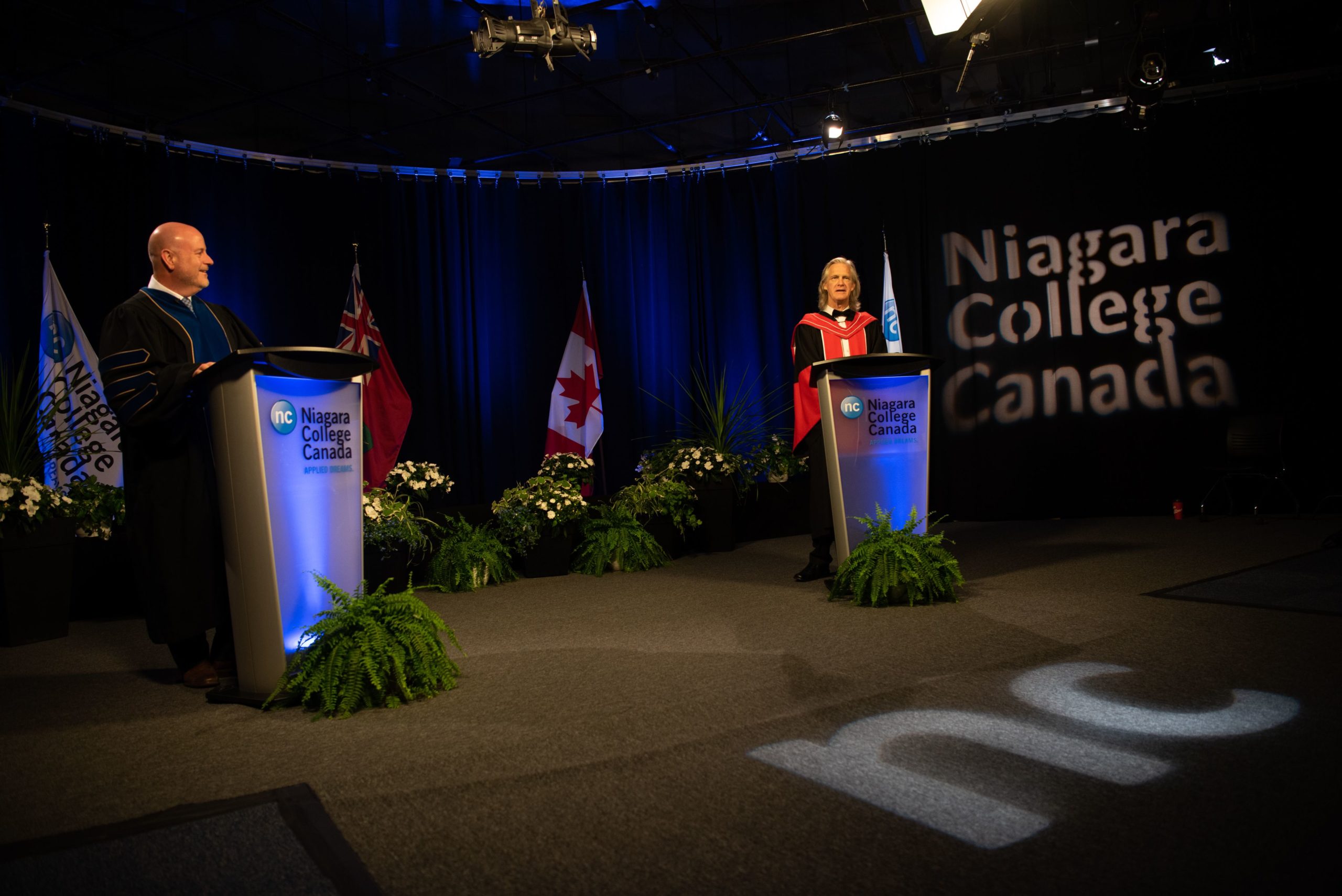
NC president Sean Kennedy and senior VP Academic and Learner Services Steve Hudson kick off the final day of Spring 2020 Virtual Convocation ceremonies.

“Pursue the opportunities that lie ahead, challenge yourself and live a life of integrity,” said College president Sean Kennedy to the Class of 2020. “Know that there are countless people who envy the blank canvass that’s staring back at you today – a canvass you will paint over time as you create your own future. Make it a masterpiece.”

Guest speaker Clara Hughes – six-time Olympian and mental health advocate – received an Honorary Diploma in Health Studies from the College and delivered a gripping convocation address to the new graduates.

“This is your special, unusual, and powerful time to be present, to be grounded, to celebrate and to connect,” she said.

Guest speaker Clara Hughes receives her Honorary Diploma in Health Studies at home in Canmore, Alberta.

Hughes shared words of wisdom, which she learned from a revered leader in the Squamish First Nation before she competed in the Vancouver 2010 Olympic Games.

“He told me, ‘Clara, I know that you’re a competitor and I know that you’re in an individual sport and I know that this is the Olympic Games,’ but what he said was, ‘you cannot want this greatness for yourself unless you want it for every single person around you. You have to look at your competitors and want success for them and, only then, can you ask for it for you.’”

June 19 ceremonies

The final day of ceremonies celebrated 524 graduates from the School of Academic and Liberal Studies in the morning, and 298 from the School of Environment and Horticulture in the afternoon.

Lindy Brunarski

Horticultural Technician graduate Lindy Brunarski was announced as the Dean’s Award from the School of Environment and Horticulture Studies with a 97 percent GPA. As a working paramedic – and alumnae from NC’s Paramedic (2005) and Advanced Care Paramedic (2008) programs – Brunarski decided to return to the classroom to enhance her passion for gardening out of interest, rather than to pursue a new career.

The Welland resident has a 23-acre farm in Pelham with 19 flowerbeds, a forest to manage, and five acres of agricultural land she hopes to convert into a small nursery and market garden someday. She has already been applying her skills from the program to help her achieve her goals of transforming the property to create a public gathering space.

“I find that the mental reprieve that I need from my work as a paramedic is often found by being outside in nature or the garden beds,” she said. “I am now a proud ‘horticultural paramedic.’”

Faisal Alsafadi, 34, graduated from General Arts and Science during the morning ceremony with a 94 percent GPA, a Dean’s Award from the School of Academic and Liberal Studies, and his family and friends watching from Ontario and Saudi Arabia where he was born and raised.

Faisal Alsafadi

“I was looking forward to our formal graduation, as every student hopes, to share our accomplishment with family and friends,” he said. “But we are also part of a time in history that will make our virtual graduation a unique one that uses my passion in the IT field to its full advantage.”

Since immigrating to Canada in the fall of 2017, Alsafadi has been residing in St. Catharines and been as enhancing his education as well as being an active volunteer in the community. He enrolled in his current program with a Bachelor of Science (Computer Science) under his belt, and previously completed two Occupation-specific Language Training courses, and the General Arts and Science Enhanced Language Training for Employment program at NC.

“The General Arts and Science program gave me the opportunity to advance my English skills and explore computer studies in the College,” he said. “Following other immigrants’ success stories of their struggles and eventual achievements since landing in Canada, inspires and motivates me to work hard to accomplish my dreams.”

Virtual Convocation 2020

Niagara College’s first-ever Virtual Convocation ceremonies, held from June 15 to June 19, have been drawing thousands of viewers from around the world – with 17,515 viewers from 63 countries on July 15, 11,732 viewers from 44 countries on July 16,  9,589 views from 42 countries on July 17, and 11,135 views from 78 countries on July 18.

The interactive live ceremonies offered graduates the chance to hear their names called out and see them appear on screen. They had an opportunity to connect with their classmates via Zoom parties held alongside the formal ceremonies, and could be seen smiling, waving and cheering intermittently during the livestream – many of them with their families and pets, as they participated from their homes. Social media posts using the #NCGrad2020 hashtag were also incorporated into the ceremony.

College president Sean Kennedy and senior vice president, Academic and Learner Services, Steve Hudson hosted all 10 ceremonies for the week on campus. The events also acknowledged Hudson’s final NC convocation prior to his retirement, after 20 years as a senior leader at the College.

Virtual Convocation featured numerous video well-wishes from across the College community – including members of faculty, staff and administrators; the College’s Board of Governors chair John Scott; and College Student Administrative Council president Tom Price.

Several members of the alumni community welcomed the new graduates in a video message – including president of RW&Co. Lora Tisi (1979), and Tim Hansing, CEO and co-founder of Red Planet Hotels (1987), Niagara EMS chief Kevin Smith (1992), TV host and reporter Amy Audibert (2012) who also voiced the opening video for the ceremony.

In addition, video greetings were played from Prime Minister Justin Trudeau, Minister of Colleges and Universities Ross Romano, and Niagara regional chair Jim Bradley.

Each ceremony also included an Indigenous welcome from traditional knowledge keeper Karl Dockstader; music from piper Kelley Buckley; and a special video of the national anthem sung by College faculty Barbara Mantini, Giacomo Folinazzo and Paul Wintemute. Names were read by faculty members Franco Bieri and Carolyn Ambrose-Miller.

Two ceremonies took place each day, livestreamed from the College’s Welland Campus, thanks to faculty from the Broadcasting – Radio, Television and Film program, and College staff. The production was an applied learning experience for a group of 10 students from the program who assisted.

All Spring 2020 Virtual Convocation ceremonies may be viewed on the Virtual Convocation website at niagaracollege.ca/virtualconvocation/

Niagara College offers more than 130 diploma, bachelor degree and advanced level programs; as well as more than 600 credit, vocational and general interest Part-time Studies courses. Areas of specialization include food and wine sciences, advanced technology, media, applied health and community safety, supported by unique learning enterprises in food, wine, beer, distilling, horticulture and esthetics. For more information visit niagaracollege.ca.

Top photo: A group of new graduates from the Commercial Cannabis Production program cheer as after their names are called out during the livestream ceremony on the afternoon of June 19.


-30-

Convocation 2020 media releases:

June 18: Critical skills for critical times: Niagara College celebrates 2020 Community and Health grads

June 17: Media, Trades and Technology graduates steal the spotlight on third day of Virtual Convocation

June 16: NC hosts second day of virtual convocation: Celebrating ‘lessons learned along the way’

June 15: Niagara College community unites to celebrate Class of 2020

June 12: Niagara College’s top graduate reaches for higher calling

June 10: Six-time Olympic medalist Clara Hughes to address Niagara College Class of 2020


Media inquiries, please contact:


Julie Greco

Communications Consultant, Niagara College

Cell: 905 328 2532

[email protected]


Michael Wales

Manager, Corporate Communications

Cell: 905-328-4101

[email protected]